
Why UAE Businesses Are Moving Printer Costs from CAPEX to OPEX
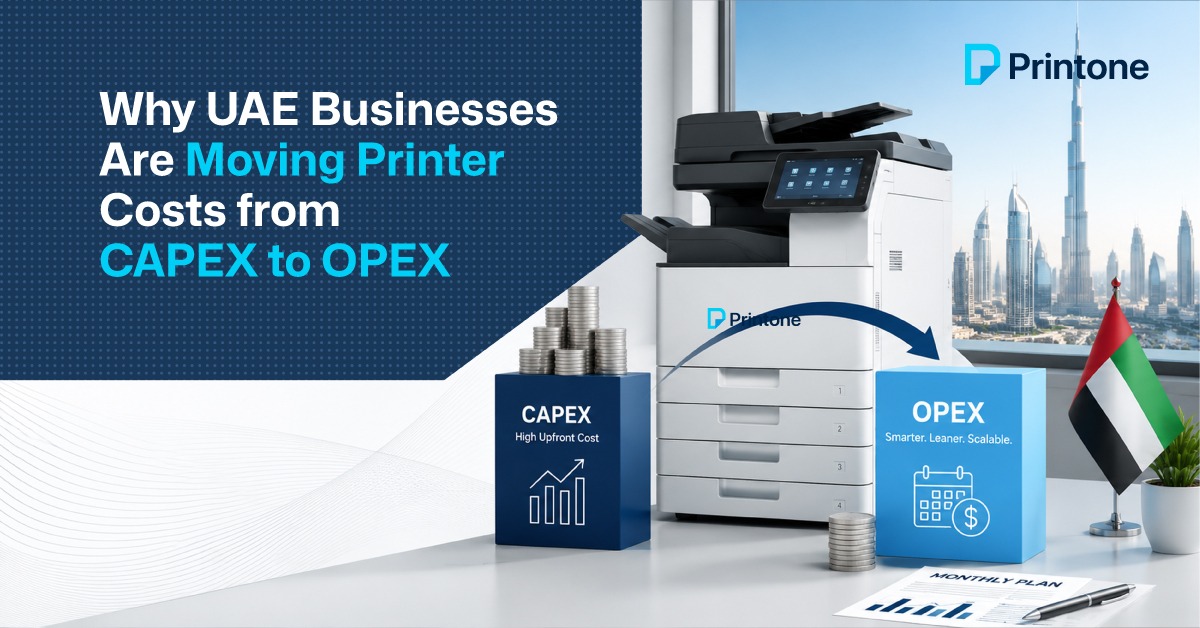
For many businesses, the decision to purchase office printers has traditionally been straightforward.
A requirement comes in.
Procurement requests quotations.
Finance approves the capital expenditure.
The equipment is purchased, added to the asset register, and the discussion ends.
At least, that’s how it appears on paper.
What rarely gets discussed is everything that happens after the purchase.
Maintenance contracts.
Unexpected breakdowns.
Consumables.
Replacement parts.
Emergency service calls.
Downtime that affects multiple departments.
Additional printers needed when the business expands.
Over time, what started as a one-time purchase quietly becomes an ongoing operational commitment.
This is one of the reasons many businesses across the UAE are rethinking how they invest in office printing. Instead of treating printers as capital assets, they’re increasingly moving towards printer rental in the UAE and Managed Print Services (MPS), where printing becomes a predictable operational expense rather than an unpredictable capital investment.
The conversation is no longer about buying a printer.
It’s about buying certainty.
The Purchase Price Is Only One Part of the Cost
During discussions with finance and procurement teams, one question often changes the direction of the conversation.
“What will this printer actually cost over the next five years?”
Not the purchase price.
The actual cost.
That includes servicing.
Consumables.
Replacement parts.
Technical support.
Device downtime.
Future upgrades.
Additional devices as teams expand.
When these costs are viewed together, the original purchase price becomes just one part of a much larger financial picture.
This is why finance teams are increasingly evaluating Total Cost of Ownership (TCO) instead of focusing only on acquisition cost.
CAPEX Makes Sense – Until Business Requirements Change
Capital expenditure has its place.
For long-term infrastructure that remains relatively unchanged, ownership can be the right approach.
Office printing, however, doesn’t always remain static.
Businesses recruit.
Departments grow.
New branches open.
Document volumes increase.
Business priorities shift.
We’ve seen organisations purchase printers that perfectly matched their requirements at the time, only to discover a year later that they were either underpowered for increased demand or oversized after operational changes.
The printer wasn’t a poor investment.
The business simply evolved faster than the infrastructure.
Finance Wants Predictability More Than Surprises
One thing finance departments consistently value is predictability.
Budgets are easier to manage when costs remain consistent.
Unexpected repair invoices.
Emergency part replacements.
Large consumable purchases.
Sudden equipment failures.
None of these are welcome during budget reviews.
With printer rental in the UAE, businesses typically move towards a predictable monthly operational cost that includes the equipment, service, maintenance, and in many cases, genuine consumables.
Instead of preparing for unexpected printing expenses throughout the year, organisations gain greater visibility over their operating costs.
For finance, that creates fewer surprises.
For management, it creates better forecasting.
Cash Flow Matters Just As Much As Cost
A common misconception is that the lowest purchase price automatically represents the best financial decision.
In reality, preserving cash flow is often equally important.
Capital tied up in office equipment cannot be invested elsewhere.
That same budget might be required for recruitment.
Technology upgrades.
Sales expansion.
Marketing initiatives.
Or opening another office.
This is one reason many growing businesses prefer operating expenditure for non-core assets.
Rather than committing a significant amount of capital to equipment that depreciates over time, they retain financial flexibility while continuing to access the technology they need.
Procurement Looks Beyond the Hardware
Modern procurement isn’t simply about sourcing equipment at the lowest possible price.
It’s about selecting solutions that reduce operational risk.
When evaluating office printing, procurement teams increasingly ask questions like:
- What response time is guaranteed?
- Is preventive maintenance included?
- How quickly can replacement devices be provided?
- Are genuine consumables supplied?
- Can additional devices be introduced as the business grows?
- Can the fleet be standardised across multiple locations?
Those answers often have a greater impact on long-term value than the printer specifications themselves.
Scalability Is Difficult to Buy – But Easy to Plan
One of the biggest advantages of working with an experienced Managed Print Services provider is flexibility.
Business requirements rarely stay the same.
A company may secure a major project that temporarily increases staffing.
Another may open a new office in Business Bay or expand its operations into Abu Dhabi.
Some businesses experience seasonal peaks where printing volumes rise significantly before returning to normal.
A well-planned printer rental solution takes these possibilities into account.
Instead of recommending hardware based solely on today’s print volume, experienced providers assess expected business growth, departmental workflows, expansion plans, and future scalability.
If additional devices are needed, they can be integrated into the existing environment.
If requirements reduce, the infrastructure can be adjusted accordingly.
The objective isn’t simply to supply printers.
It’s to ensure the print environment continues supporting the business without unnecessary capital investment every time circumstances change.
IT Benefits Too
Although the financial model changes, the operational benefits are equally important.
When office printing is managed through a structured service model, IT teams spend less time coordinating repairs, sourcing consumables, managing multiple vendors, or responding to recurring printer issues.
Instead of reacting to problems, they can focus on strategic initiatives that directly support the organisation.
For growing businesses, that’s a significant operational advantage.
It’s Not About Renting Because It’s Cheaper
One assumption we occasionally hear is that businesses choose printer rental in the UAE simply to reduce costs.
In practice, the decision is rarely that straightforward.
Many organisations move from CAPEX to OPEX because they value flexibility.
Predictability.
Scalability.
Service accountability.
Business continuity.
The financial savings become one benefit among many- not the only reason behind the decision.
A Different Way of Looking at Office Printing
The question finance teams are increasingly asking isn’t:
“How much does this printer cost?”
It’s:
“How much effort, risk, and ongoing investment does this printer introduce over its lifetime?”
Those are very different questions.
The first compares prices.
The second evaluates business value.
As organisations across the UAE continue to prioritise operational efficiency, cash flow management, and scalable infrastructure, it’s no surprise that more businesses are shifting office printing from a capital purchase to an operational service.
Not because they need another printer.
Because they need a smarter financial and operational model that grows with the business.
Comments are closed